Categoria / Category Traveled places

Chacaltaya and Valle de la Luna


We left early to visit the famous peak, Chacaltaya. It is the highest ski resort in the world (more than 5000m above sea level). In the way there, we could see diverse snow peaks and volcanoes. Each one of them has a legend to the indigenous people. At the ski resort, it was very cold and there were strong winds. One of the friends of tour stayed in the car, she not even tried to go up the top.

We start to go up, slowly, at 5270m. When I was half way, I did not feel very well, I was cold, had headache and my legs were trembling. I was afraid of sliding down, I stopped a little to photograph and I decided to go down.

I had a coca leaf tea in the resort cafe and stayed enjoying the landscape. There was nobody skiing because the weather was not appropriate. After some minutes, the rest of the group started to show up. Many had given up to go to the top. From we went back to the city and we head to the Valle de la Luna, a place few kilometers south of La Paz, that looks like the moon...

Leia Mais... / Read More...

Copacabana and Lake Titicaca

After some weeks blocking the roads to Copacabana, farmers decided to open the roads for 10 days, as a negotiation period. I arrived in the city late afternoon; I left my backpack in the hotel and went to see the sunset in the Titicaca lake. Beutiful, relaxing…

Next day, I made a boat tour to the islands. First we visit the north part of Isla del Sol, it was two and a half hours by boat. We had only two hours to visit the place, it was not much time. One option would be  to walk quickly to the ruins or second, to enjoy the landscape photographing but not seeing everything. I opted for the second.

From there we went by boat to the central part of the island, where there is an etymologic museum. A complete waste of time. The museum had almost nothing and it took 45min to get there by boat. Then took us one more hour by boat to go to Isla la Luna. There we walked quickly to the ruins, we took photos and it was already time to go back...

Leia Mais... / Read More...

Rurrenabaque and the Pampas

The trip to Rurrenabaque was long. First I caught a transport (to go on foot, pressed, in the trunk of a pick-up truck) to Yolosa. From there, I got a bus to Rurre (it is how they call Rurrenabaque here). We arrive there really early, at 5am, and we stayed sleeping in the bus waiting to day light up. When we woke up, we were to get our backpacks from roof of the bus and the backpack of a Scottish guy had been stolen. There are lots of robberies stories around here… I went to the hotel, I took a shower and an excellent breakfast in a restaurant close by. I confirmed my tour to the following day and spend the rest of the day doing nothing. It was happy in being in a hot place. Sometimes the cold tires me off.

The tour was a disaster. We left 2 hours late, then travel 4 hours to a small town called Santa Rosa. After waiting a long time for the food, that they did not have enough, we left for 3 more hours by boat in the river Yacuma to the campsite...

Leia Mais... / Read More...

Bicycle tour to Coroico

I had seen on tv as well as met people who had done this tour before. So I decided to do a bike tour in the “most dangerous road in the world”, it is from La Paz to Coroico.

We left La Paz at 8:30am and went by a bus van to the highest point called La Cumbre. There we got our bikes to go down. In the first kilometers the road has pavement and it was not too busy. We could reach hight speed. Some say it can be 70km/hour, for sure I was not one of those.

After a short period of time we stopped to see the landscape and have a chocolate, after all, it was really cold. At La Cumbre it was snowing and with the cold wind of the speed, I had the feeling of freezing. We went up a little bit to reach the end of the pavement. There were many tractors and trucks on the road and then it started the unpaved road. Here it began the very dangerous part of the tour. From there on, we had to go down by the left side of the road, that means, the side of the precipice...

Leia Mais... / Read More...

La Paz – Culture

When I am traveling and photographing I always avoid going to big cities. I think they all look alike, it does not matter in which part of the world they are. In this trip I’m using the days in big cities to work on the website. It is where there are the best Internet Cafes. It is also the best place to do cultural programs.

I decided to visit some museums, the first was the Museo de Etnografia y Folklore. It is downtown in an old building, it shows some indigenous cultures with mockups, maps, objects and videos. It also has a video library where people can watch and buy videos. I bought a well interesting book on legends and popular myths from Bolivia.

The next museum was the Museo Nacional del Art, also located downtown, it is not very large. The best part of the visit was exhibition of the work of a Bolivian fine artist called Ines Cordoba. There were many rooms with her work. For me the best was the work done in with metal...

Leia Mais... / Read More...

Laja – Tiahuanaco

I left at 9am to a tour in Tiahuanaco. In the way we stopped in the small city called Laja to visit the Baroque Mestizo style church. This was created to commemorate the victory of the Spaniard on the Incas. On the left side, there are Inca symbols as the condor, while on the right there are catholic symbols. The visit the Tiahuanaco starts in the local museum that shows indigenous objects from the region. We learned a little about the pre-Colombian cultures and went for a walk in the ruins.

Tiahuanaco was perhaps the most important culture in Bolivia. It was divided in 5 phases, the first it is believed it appeared 10 centuries before Christ, while that fifth it finished around 1200 DC. After this time the Incas arrived in the region and they took care of the temples.  Popular legends say that Viracocha (the greatest God, creator of the world) lived there...

Leia Mais... / Read More...

Border Peru – Bolivia


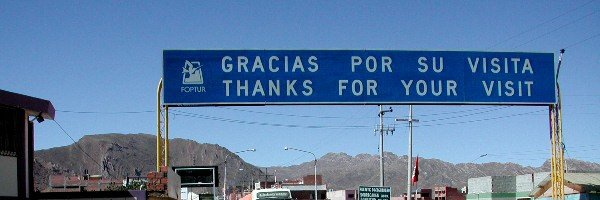
Crossing the border from one country to another is not a good experience around here. It is even worse if there is threats of closing the roads by the Bolivian farmers that were on strike. I knew I couldn’t go to Copacabana because the roads were closed as a form of protest. I went to the Bolivian consulate to know if I would have problems and they told me to cross the border through Desaguadero (a frontier city in Peru). It should be a longer but safer way.

I left very early so I would have more time in case of getting stuck somewhere. The 3-hour trip to Desaguadero had no problems, therefore the road was good. In the city we had to get off the bus with the backpacks, go in-line to the Peruvian immigration to give the exit stamp on the passport and cross the border walking. On the other site there was a bus waiting for us. We spent some more time in-line in the Bolivian immigration to get the entrance stamp. They gave me a 30-day visa even though I said I wanted to stay longer...

Leia Mais... / Read More...

Puno and Titicaca Islands

I arrived in Puno early in the morning after a 12 hour bus trip from Arequipa. I went straight to look for transport to the Titicaca Islands. I had lunch and went back to the hotel wait for some Brazilian friends who were supposed to meet me there. It would be the first time that someone “from home” would meet me. They, Jeferson and Carol, arrived in that afternoon. They were late in their itinerary due to the farmer’s strikes in Bolivia. They decided not to visit the islands and go straight to Cuzco. We had diner, then they got the bus.

Next day I depart in a two-day tour to the islands. First we visited an Uro island. Casually the island was called Santa Maria, the same name of my hometown. It is very small and all made with reed. They first put the reed roots and then the dried reed. As the time goes by the roots are growing and gives resistance to the “ground”...

Leia Mais... / Read More...

Arequipa – Earthquake

I was in Cuzco, walking in to an agency to know the price of a bus ticket to Arequipa when the woman told me not to get in and walk out the store. Outside she told me it was happening an earthquake. I haven’t felt it, only when she said, I realized the walls were moving. There was music in the streets and people were dancing to commemorate Inti Rayme, they were not feeling the trembler.

After a few days I want to Arequipa. The bus trip takes 12 hours. The road that is usually awful, after the earthquake was even worse. The bus was full, children were sleeping on the aisle and a woman by my side was throwing up the whole trip. At this time I was thinking if it was really worthwhile to visit Arequipa.

The answer was yes. The city is beautiful, almost all constructed with volcanic white rocks called “sillar”. The colonial architecture of the buildings, arches, churches are a reason to go there. Another is the climate...

Leia Mais... / Read More...

Cañón del Colca

I wanted to do a 3-day trekking in the Colca Canyon. Since the area was in alert of another possible earthquake, any travel agency wanted to organize a tour there. I talked to a local guide, he suggested me not to go down the canyon, that could be very dangerous at this time. I decided then to do a two-day tour in the canyon. In the city exit we already could see the volcanoes: Mist (means gentleman), Chachani (means well dressed, referring to its snow top) and Pichu Pichu (means peak). In the way we stopped to see Vicuñas (a wild relative of the llamas) in the Reserva Nacional de Salinas y Aguada Blanca. An hour later we stopped to have a coca leaf tea to go through the highest point of the tour.

From the viewpoint we could see the volcanoes and the snow peaks in the area. In this place people do offerings to Pachamama to protect the travelers, these are called “Apachetas”. It is a pile of rocks with coca leafs under it...

Leia Mais... / Read More...